CSF recently attended London Climate Action Week to share work on the New Zealand Taxonomy and to gather insights that can help shape the future of sustainable finance here in Aotearoa New Zealand.
Across dozens of discussions with financial institutions, policymakers, and the international sustainable finance community, six themes consistently emerged.
Watch Andy O’Hare, Head of Strategy, and Jessica Desmond, Head of Taxonomy, present the insights:
1. Sustainable finance is becoming further embedded in business as usual
Despite a challenging geopolitical environment and changing political narratives, the transition to a low emissions economy continues to gather momentum.
Market participants reported that sustainable finance remains one of the world’s largest investment themes, with activity increasingly focused on implementation rather than new announcements. The conversation has shifted from making commitments to delivering them through practical frameworks, market settings and investment opportunities.
2. Expectations of finance are being reset
One of the strongest themes throughout the week was a growing recognition that financial institutions cannot deliver the transition on their own.
Banks, insurers and investors have clear mandates, fiduciary duties and commercial responsibilities. While they play a critical role in financing the transition, they cannot create investable opportunities where supportive policy, regulation and long-term planning do not exist.
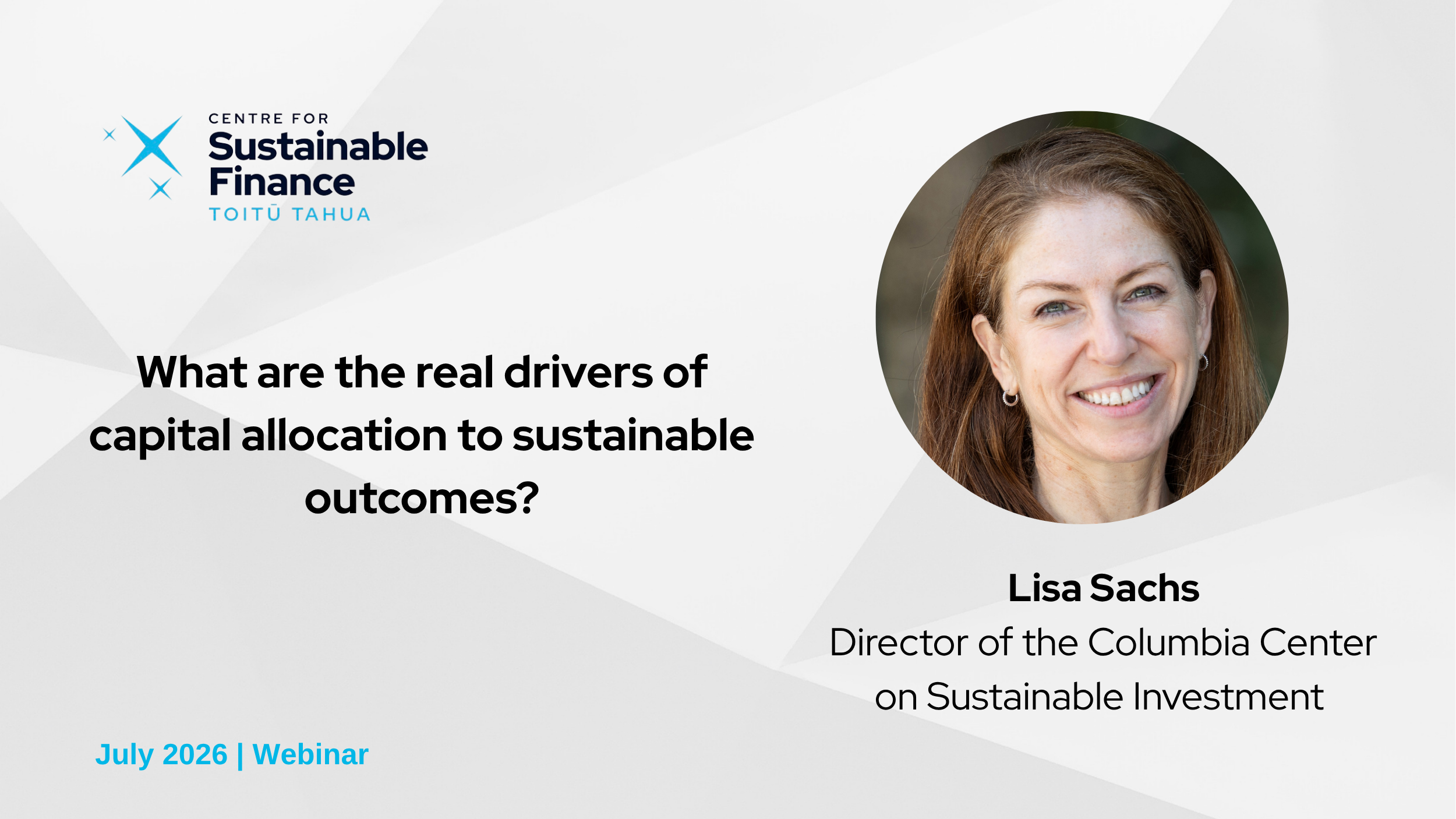
This reinforces an important message CSF discussed recently with Professor Lisa Sachs of Columbia University: climate change cannot be solved through better financial risk management alone. Decarbonisation, supported by clear government direction and system-wide planning, is essential to reducing underlying climate risk.
3. Adaptation and resilience are becoming more central within sustainable finance discussions
Adaptation and resilience featured prominently throughout London Climate Action Week, reflecting growing recognition that countries must prepare for the physical impacts of climate change alongside reducing emissions.
However, investment continues to lag. While there is increasing interest from private capital, scalable investment opportunities remain limited.
Many participants pointed to well-designed public policy or regulation as the key enabler for unlocking greater private investment in resilience projects, particularly those delivering benefits at landscape or community scale.
4. Sustainable finance is expanding beyond climate
Conversations are increasingly broadening beyond emissions reduction to consider wider environmental, social and community outcomes.
Participants discussed the importance of understanding co-benefits, including biodiversity, employment and broader societal impacts. At the same time, there was recognition that expanding frameworks also increases complexity, raising important questions about measurement, verification and the appropriate role of financial markets.
5. Collaboration is becoming even more important
A recurring message throughout the week was that successful sustainable finance depends on strong collaboration between governments, regulators, financial institutions and the real economy.
Internationally, New Zealand’s public-private partnership approach to taxonomy development attracted significant interest. Bringing together policymakers, market participants and technical experts was widely seen as helping to develop practical tools and accelerate market adoption.
6. Physical climate risk remains an emerging frontier for financial institutions
Financial institutions continue to improve their understanding of the financial risks posed by floods, storms, heat and other physical climate impacts.
While sophisticated risk modelling and proactive client engagement is becoming more common, there is still limited evidence that insights and data are consistently informing decisioning.
Participants also highlighted an important challenge: if only some institutions begin pricing physical climate risk into their decisions, they may be placed at a near-term competitive disadvantage. This suggests a coordinated, sector-wide approach may ultimately be needed.
New Zealand’s Taxonomy continues to gain international recognition
The New Zealand Taxonomy was also a major focus of CSF’s programme in London.
The project received the Climate Bonds Initiative Award for Most Innovative Taxonomy, recognising its evidence-based approach to agriculture and forestry, and its inclusion of adaptation and resilience criteria alongside mitigation from the outset.
Discussions with international taxonomy developers also highlighted growing collaboration across the Asia-Pacific region, increasing attention on interoperability between taxonomies, and a shared focus on making taxonomies simpler to implement and more useful for businesses.
Publishing criteria is seen as only the beginning. Ongoing guidance, technical support and practical implementation will be critical to achieving widespread market adoption.
As sustainable finance continues to evolve, these international insights will help inform CSF’s work to support New Zealand’s financial system in mobilising capital towards a more resilient, competitive and sustainable future.