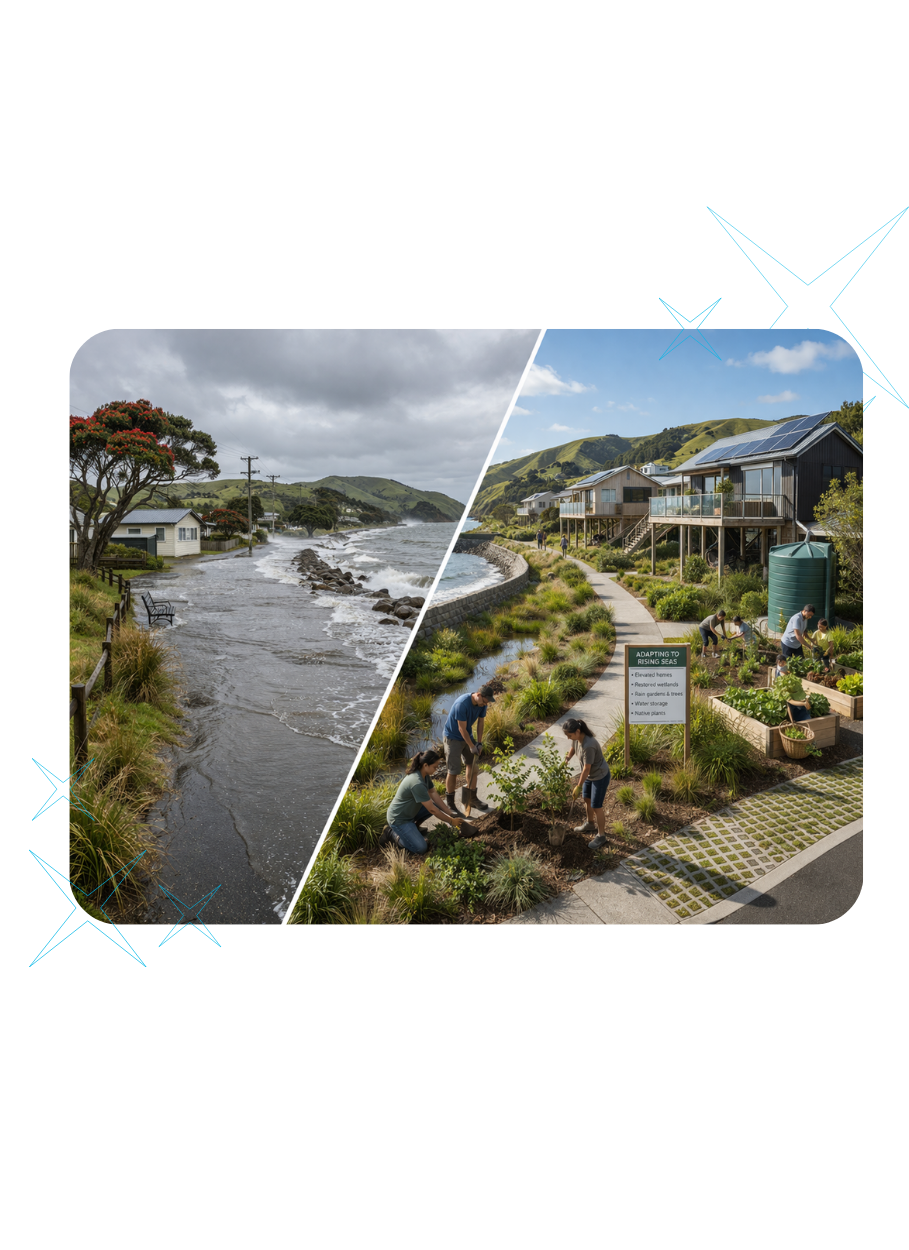
Examining how to scale private finance for adaptation and resilience projects

What will it take to scale private capital for adaptation and resilience?

New Zealand will need substantially more investment to help communities, infrastructure and the economy adapt to more frequent extreme weather and intensifying climate-related hazards. 

CSF is examining what is needed to enable financial institutions to provide and scale financing for adaptation and resilience projects and amplify the impact of public funding in this space. 

Building on our role as a financial-system convenor, we are working with partners across government, finance, business and Māori organisations to identify the barriers to investment, where private capital can play a greater role, and the policy, market and financing conditions needed to unlock it. 

Our findings will be published in October 2026. 

Shouldn't 'green' and 'transition' finance
take priority?

Climate hazards will continue to intensify as the world warms. Reducing the underlying risk ultimately depends on accelerating global decarbonization and this remains an area of focus for CSF.  

While New Zealand cannot control the global trajectory of climate change, the resilience of its towns, cities, communities and businesses is within its control. As weather events become more frequent and severe, and recovery costs increase, investment that reduces future losses becomes increasingly economically rational.  

Where the cost of proactive risk reduction is lower than the losses it avoids, returns on investment can be substantial. Many of these benefits take the form of avoided costs, highlighting that greater resilience provides a foundation for future economic growth. 

The consequences extend beyond individual assets and communities. If climate risks are not managed effectively, they can affect insurance availability and affordability, property values, lending and investment decisions, public finances and, over time, New Zealand’s cost of capital. 

The scale of the adaptation challenge will require significant planning, coordination and investment. Public funding will remain essential, but it cannot meet the challenge alone. 

Building on work already underway across government, industry and research institutions, CSF aims to strengthen the evidence base for decisions about where and how financial institutions can provide financing for adaptation and resilience, what currently constrains that financing, and where policy, regulation or market development could remove those barriers. 

How does this relate to sustainable finance approaches and products?

Sustainable finance is concerned with how the financial system supports long-term economic, environmental and social outcomes while managing material risks. 

Adaptation and resilience present a particular financing challenge. Many projects create substantial economic and social value, including by reducing future losses, but do not generate the direct or predictable revenue streams typically required by private investors. 

For private capital to play a greater role, suitable projects need to become financeable. That may require different approaches to allocating risk, generating or capturing value, combining public and private capital, and structuring investment. 

Our research will examine these barriers and the practical opportunities to overcome them, with the aim of supporting greater investment in the resilience and long-term prosperity of Aotearoa New Zealand.

Our approach

We are undertaking targeted research, engaging stakeholders, and producing a Market Gaps Report to better understand barriers to capital flow.

From there, we will establish a pipeline of priority adaptation and resilience projects and work collaboratively with project partners to design scalable financing solutions and produce business cases to enable solutions to be piloted in-market.

Through this approach, we aim to demonstrate how capital can be mobilised more effectively into underfunded areas, while sharing insights to support broader system-wide progress.

Timeline

April 26

Stakeholder Engagement and Secondary Research

June 26

Project pipeline development

August 26

Market Gaps Report published

October 26

Project selection and kick off

March 27

Indicative business cases published

May 27

Pilot development and knowledge sharing

Expressions of interest for financing projects

We want to hear from anyone looking to mobilise or better utilise private capital to finance adaptation activities and enhanced resilience of your entity, region or catchment against the increasing adversity of weather events. 

If you submit an expression of interest one of our team will come back to you to determine whether working with us might be beneficial.

Adaptation & Resilience

"*" indicates required fields

Read more about our work supporting New Zealand’s energy transition 

Subscribe

Enter your name and email address to subscribe.

Close

About

Our Work

Current Work

Past Work

News and resources

Resources