
A 2030 Strategy for financing sustainable growth in Aotearoa New Zealand

In response to a request from the Minister of Climate Change, in February 2025 CSF made recommendations to the New Zealand government for a national sustainable finance strategy. We call this a 2030 strategy for financing sustainable growth. Our recommendations were developed through engagement across the public and private sectors. 

Our vision for New Zealand is:

Finance that unlocks New Zealand’s potential and enables the growth, innovation and capital required for current and future generations to thrive.

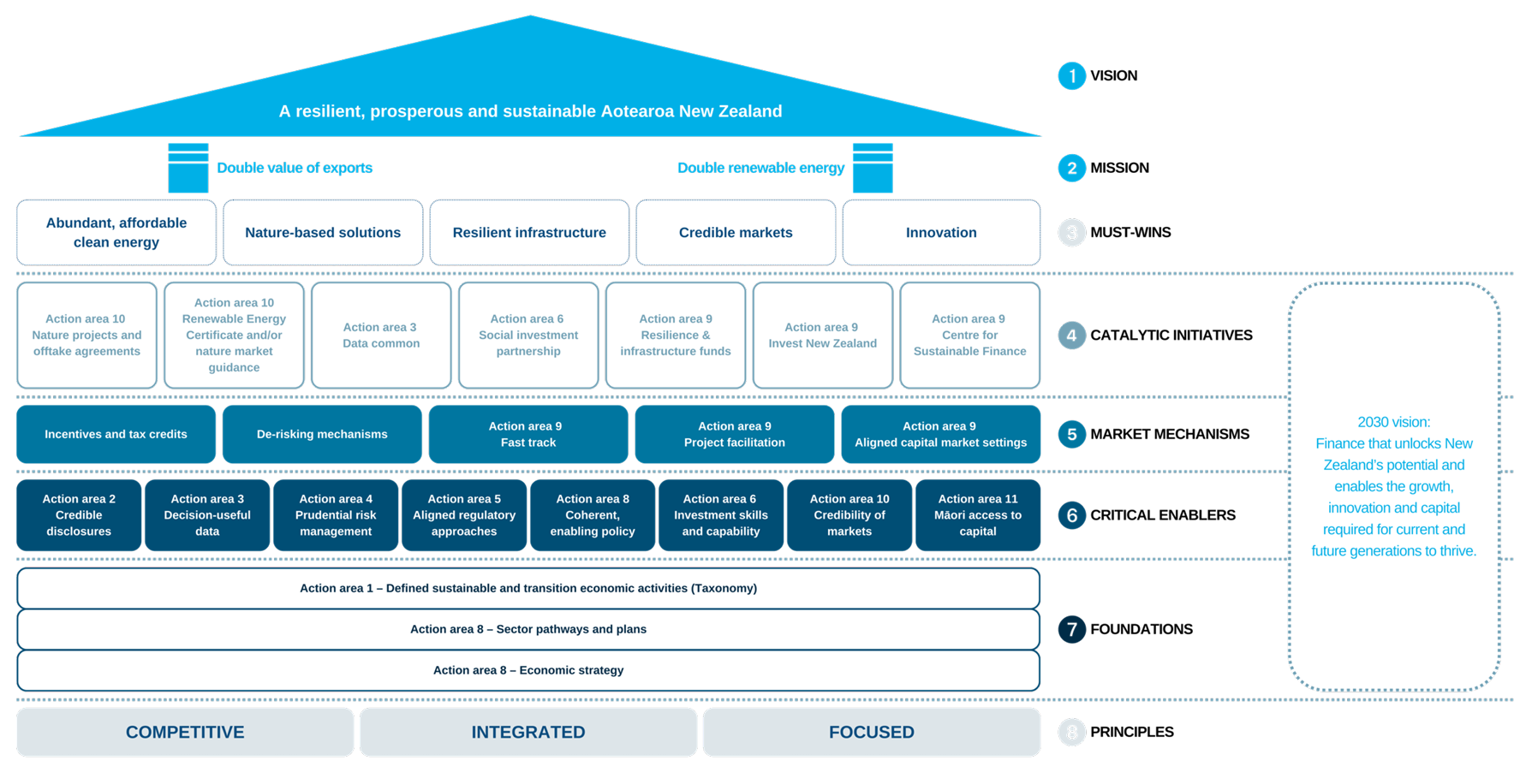
We identified building blocks and catalytic initiatives for financing Aotearoa New Zealand’s economic transformation

Why does New Zealand need a 2030 strategy for financing sustainable growth?

The New Zealand Government has an ambitious economic growth agenda that aims to unlock New Zealand’s potential, grow the economy and ease the cost of living for New Zealanders.  

The Government’s growth aspirations are set in the context of unprecedented change – including a rapidly warming climate, ageing populations, increased geopolitical and trade tensions, and technology change. The speed and scale of these changes have the potential to destabilise economies, strain public resources, disrupt labour markets, and increase vulnerability to global conflicts. 

Making capital flow to the right places to respond to these goals and challenges is difficult. This is partly due to a short-term focus, as well as a lack of tools to effectively assess trade-offs and accurately price social and environmental risks. To achieve the Government’s desired outcomes from growth, we need clear and cohesive government policies and regulation that can effectively attract, mobilise and direct both public and private capital. 

Finance is often referred to as the lifeblood of an economy given the important role it plays in enabling economic growth and employment. Yet, where finance flows matter not just for how fast we grow (the rate), but also for how we grow (the direction).

Focusing on activities that strategically support the transition to a low-emissions global economy can yield benefits in both the short and the long term. Investing in renewable energy, sustainable agriculture, and green technologies not only mitigates environmental risks but also creates new economic opportunities, enhances resilience, and promotes social equity. 

The vision for this strategy is:

Finance that unlocks New Zealand’s potential and enables the growth, innovation and capital required for current and future generations to thrive.
Recommended strategic priorities

The strategy prioritises delivering a stable and predictable policy and regulatory environment that promotes investor confidence and trust. Three priority outcomes are:

  1. Clarity and confidence in financial markets
  2. Coherent policy and regulation

Key objectives

Alongside the Government’s Going for Growth plan, this Strategy is focused on five objectives that will deliver on the goal for a thriving New Zealand:  

  1. Meet our climate change commitments
  2. Adapt to the impacts of climate change that can’t be avoided
  3. Double the value of exports
  4. Double renewable energy
  5. Test and scale new methods of social service delivery

CSF recommends twelve action areas

1. Defining sustainable economic activity for Aotearoa New Zealand

a.) Publish the Agriculture and Forestry sectoral taxonomy definitions for mitigation, adaptation and resilience activities by November 2025. (Lead Agency – MfE, Ministerial portfolios – Climate Change, Agriculture, Forestry)

b.) Expand the taxonomy’s sector coverage, by developing and publishing definitions against the mitigation objective (and adaptation and resilience objective where relevant) for the Energy, Transport, Buildings and Construction sectors by November 2026. (Lead agency – MfE, Ministerial portfolios – Climate Change, Energy, Transport, Buildings and Construction). Learn more.

a.) Consult on differential climate reporting to ensure that NZ CS continue to meet the legislated purpose of climate-related disclosures while maintaining international alignment with key trading partners. (Lead agency – XRB, Ministerial portfolio – Commerce & Consumer Affairs)

b.) Carefully consider the feedback provided during the consultation process on the Capital Markets Reforms on adjustments to the climate-related disclosures regime in New Zealand by November 2025. (Lead agency – MBIE, Ministerial portfolio – Commerce & Consumer Affairs)

c.) Publish guidance on simplified sustainability disclosures by June 2026 for New Zealand businesses which are outside the climate-related disclosures regime but still exposed to evolving consumer and export market requirements and expectations. (Lead agency – XRB, Ministerial portfolio – Commerce & Consumer Affairs) Learn more.

a.) Explore options for establishing a data common or ‘centre of excellence’ by November 2025. (Lead agency – TBC, Ministerial portfolio – TBC)

b.) Ensure alignment between sustainability disclosure requirements and priority data needs of capital providers and regulators. (Lead agency – TBC, Ministerial portfolio – TBC) Learn more.

a.) Continue to identify and assess current and emerging environmental risks to the financial system and develop options to enhance the resilience of their core functions. (CoFR agencies)

b.) Gather and assess evidence of quantifiable links between shifts in physical and transition risk factors and financial stability criteria. (RBNZ)

c.) Investigate the capabilities, settings, and frameworks required to set up and administer funding arrangements to mobilise capital from financial institutions to enhance climate resilience. This will establish an evidence base to inform implementing these funding arrangements (see priority 9). (Lead agency – RBNZ) Learn more.

a.) Review regulator mandates to promote consistency with this Strategy, to the extent it does not unduly compromise other regulatory objectives and activities.

b.) Review existing duties and guidance to identify and remove inadvertent deterrents for Government and industry collaboration in line with the objectives of this Strategy. (Lead agency – TBC, Ministerial portfolio – Commerce & Consumer Affairs)

c.) Review approaches to address greenwashing and explore options for a product labelling scheme consistent with key jurisdictions and trading partners by November 2026. (Lead agency – MBIE, Ministerial portfolio – Commerce & Consumer Affairs)

d.) Consider options to better recognise and enable investor stewardship in New Zealand in supporting good practice and corporate accountability. (Lead agency – MBIE, Ministerial portfolio – Commerce & Consumer Affairs)

e.) Issue guidance and communications under multiple CoFR agency logos where appropriate. Learn more.

a.) Encourage public spending in line with the Government’s climate and environmental commitments (e.g. requiring new expenditures to meet the criteria set out in the New Zealand Sovereign Green Bond Framework). (Lead agency– Treasury, Ministerial portfolio – Finance)

b.) Support agencies to develop bids for eligible green bonds projects, using business cases that incorporate the effects of climate risk and impacts. (Lead agency – TBC, Ministerial portfolio – Finance)

c.) Partner with the Impact Investing Network and CSF to catalyse finance for new methods of social service delivery. (Lead agency – Social Investment Agency, Ministerial portfolios – Social Investment, Economic Growth)

d.) Expand options to build capacity among public sector and Māori leaders to ensure they have the skills to work with each other as investment partners. (Lead agency – NZTE/MBIE, Ministerial portfolio – Māori Development)

e.) Explore expansion of macro-economic modelling tools to inform climate-related policy choices in a New Zealand context. (Lead agency – TBC/RBNZ, Ministerial portfolios – Finance, Economic Growth)  Learn more.

a.) Detail bi-partisan plans to implement the committee’s recommendations in the national adaptation framework. Learn more.

a.) Build on Going for Growth to develop a comprehensive economic strategy outlining potential pathways for delivering on the Government’s goals. (Lead agency – MBIE, Ministerial portfolios – Economic Growth, Trade & Investment)

b.) Publish a clean energy plan for Aotearoa New Zealand by December 2025. (Lead agency – MBIE, Ministerial portfolio – Energy)

c.) Publish a clean transport plan for Aotearoa New Zealand by 2026. (Lead agency – Ministry of Transport, Ministerial portfolios – Transport, Energy) Learn more.

a.) Ensure that expectations of NIFFCo and Invest NZ are that they secure investments in line with national priorities and ensure that New Zealand is competitive on the world stage. (Lead agency – Invest NZ, Ministerial portfolios – Infrastructure, Trade & Investment)

b.) Review and adjust capital markets settings to better facilitate institutional investment in private assets. (Lead agency – MBIE, Ministerial portfolio – Commerce & Consumer Affairs)

c.) Encourage Crown Financial Institutions to support the objectives of the sustainable finance strategy. (Ministerial portfolio – Finance)

d.) Resource CSF to design financial structures and create market conditions where private investors can confidently fund projects that support the climate change strategy and national priorities. (Lead agency – MfE, Ministerial portfolios – Climate Change, Social investment, Energy)

e.) Recycle the Crown’s balance sheet by seeding 2-3 sustainable infrastructure and resilience funds. (Lead agency –TBC, Ministerial portfolio – Finance)

f.) Fast track sustainable investment and infrastructure projects. (Lead agency – MfE, Ministerial portfolios – Infrastructure, Environment, Climate Change) Learn more.

a.) Publish the Aotearoa New Zealand Biodiversity Strategy implementation plan by early 2026. (Lead agencies – DOC, MfE, Ministerial portfolios – Conservation, Environment)

b.) Collaborate with industry to develop a plan for a seamless nature and carbon finance system which fully utilises mandatory and voluntary markets. (Lead agency – MfE, Ministerial portfolios – Associate Environment (Biodiversity), Climate Change)

c.) Publish guidance on nature market integrity requirements. (Lead agency – MfE, Ministerial portfolios – Associate Environment (Biodiversity), Climate Change)

d.) Strategically partner with industry to drive initial demand and pilot demonstration projects. (Lead agency – MfE, Ministerial portfolio – Associate Environment (Biodiversity)) Learn more.

a.) Continue the Māori Access to Capital work programme, including refreshing and restating the outcomes and actions for the cross-agency Māori Access to Capital group. (Lead agency – Treasury, Ministerial portfolio – Māori Development)

b.) Continue establishment support for Rauawa, the National Iwi Chairs intermediary, to support it to become self-sustaining. (Lead agency – TBC, Ministerial portfolios – Finance, Māori Development) Learn more.

a.) Continue to engage strategically in key fora including Network for Greening the Financial System (NGFS), International Coalition of Finance Ministers for Climate Action, International Platform on Sustainable Finance (IPSF), Central Bank Network for Indigenous Inclusion, and Advanced Small Economies Initiative.

b.) Use bilateral and plurilateral agreements to support regional collaboration on green economy where there is value to New Zealand’s long-term economic prosperity. (Lead agency – MFAT, Ministerial portfolios – International Trade & Investment, Foreign Affairs) Learn more.

Read the full recommendations

What next?

CSF’s recommendations are now under consideration by the Minister of Climate Change.

Join our mailing list below to receive updates on our work.

Subscribe

Enter your name and email address to subscribe.

Close

About

Our Work

Current Work

Past Work

News and resources

Resources